





 Dr. John Edward Norwood "Charlie" Veron, Australien


Haltungsinformationen
Favites valenciennesii (Milne Edwards & Haime, 1849)
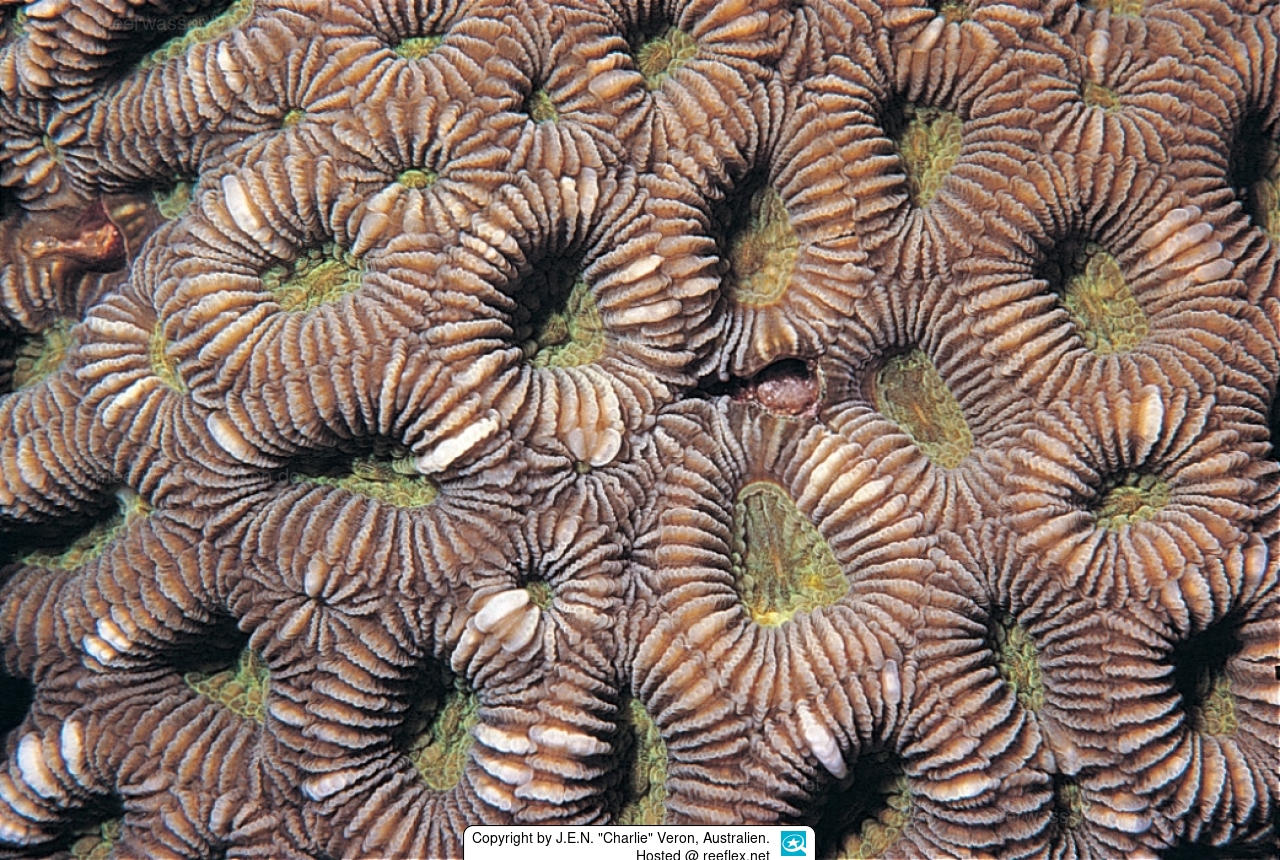
Merkmale Favites valenciennesii: Die Kolonien sind submassiv bis krustenförmig, mit kantigen Koralliten von 8–15 mm Durchmesser. „Rillen- und Höckerformationen“ sind gut ausgebildet. Lange und kurze Septen wechseln sich stark ab, sind über den Wänden verdickt und gleichmäßig gezähnt.
Farbe: Gewöhnlich grün, braun oder gelb mit weißen Septen und manchmal grünen Mundscheiben.
Ähnliche Arten: Phymastrea colemani. Siehe auch Phymastrea magnistellata.
Lebensraum: Die meisten Riffhabitate.
Synonyme:
Favia bertholleti Milne Edwards & Haime, 1857 · unaccepted > junior subjective synonym
Favia eridani Umbgrove, 1940 · unaccepted > junior subjective synonym
Favia valenciennesi (Milne Edwards & Haime, 1849) · unaccepted > superseded combination
Manicina valenciennesi (Milne Edwards & Haime, 1849) · unaccepted > superseded combination (basionym)
Montastraea valenciennesi (Milne Edwards & Haime, 1849) · unaccepted > superseded combination
Montastrea valenciennesi (Milne Edwards & Haime, 1849) · unaccepted > superseded combination
Parastrea bertholleti Valenciennes, ms · unaccepted > unavailable name (manuscript name)
Phymastraea aspera Quelch, 1886 · unaccepted > junior subjective synonym
Phymastraea irregularis Duncan, 1883 · unaccepted > junior subjective synonym
Phymastrea aspera Quelch, 1886 · unaccepted > junior subjective synonym
Phymastrea profundior Milne Edwards & Haime, 1849 · unaccepted > junior subjective synonym (?)
Phymastrea valenciennesi Milne Edwards & Haime, 1849 · unaccepted > superseded combination (misspelling)
Phymastrea valenciennesii Milne Edwards & Haime, 1849 · unaccepted > superseded combination (basionym)
Merkmale Favites valenciennesii: Die Kolonien sind submassiv bis krustenförmig, mit kantigen Koralliten von 8–15 mm Durchmesser. „Rillen- und Höckerformationen“ sind gut ausgebildet. Lange und kurze Septen wechseln sich stark ab, sind über den Wänden verdickt und gleichmäßig gezähnt.
Farbe: Gewöhnlich grün, braun oder gelb mit weißen Septen und manchmal grünen Mundscheiben.
Ähnliche Arten: Phymastrea colemani. Siehe auch Phymastrea magnistellata.
Lebensraum: Die meisten Riffhabitate.
Synonyme:
Favia bertholleti Milne Edwards & Haime, 1857 · unaccepted > junior subjective synonym
Favia eridani Umbgrove, 1940 · unaccepted > junior subjective synonym
Favia valenciennesi (Milne Edwards & Haime, 1849) · unaccepted > superseded combination
Manicina valenciennesi (Milne Edwards & Haime, 1849) · unaccepted > superseded combination (basionym)
Montastraea valenciennesi (Milne Edwards & Haime, 1849) · unaccepted > superseded combination
Montastrea valenciennesi (Milne Edwards & Haime, 1849) · unaccepted > superseded combination
Parastrea bertholleti Valenciennes, ms · unaccepted > unavailable name (manuscript name)
Phymastraea aspera Quelch, 1886 · unaccepted > junior subjective synonym
Phymastraea irregularis Duncan, 1883 · unaccepted > junior subjective synonym
Phymastrea aspera Quelch, 1886 · unaccepted > junior subjective synonym
Phymastrea profundior Milne Edwards & Haime, 1849 · unaccepted > junior subjective synonym (?)
Phymastrea valenciennesi Milne Edwards & Haime, 1849 · unaccepted > superseded combination (misspelling)
Phymastrea valenciennesii Milne Edwards & Haime, 1849 · unaccepted > superseded combination (basionym)


